How to Improve Email Deliverability for B2B Manufacturers Using Email Verification
Boost inbox placement for B2B manufacturers by cleaning email lists with real-time verification. Reduce bounces, avoid spam traps, and improve sender reputation
B2B Manufacturers Lose Revenue to Inbox Failures
You send a tailored proposal to a key decision-maker at a plant engineering firm. It never arrives. Not a bounce, not a reply — just silence. That’s not a minor glitch. It’s a lost deal. Even with polished content, B2B emails from manufacturers frequently fail before they’re read.
Why? Because inbox placement isn’t just about your message. It’s about the health of your sender reputation — and one blocked or bounced email can start a chain reaction. High bounce rates after just a few sends flag you as a risky sender, triggering filters that can block your messages permanently.
how to improve email deliverability for B2B manufacturers using email verification isn’t a side project. It’s a foundation. Clean lists, verified addresses, and real-time validation reduce bounces, protect sender reputation, and keep your outreach in view — not the spam folder.
Key takeaways
- High bounce rates from unverified B2B lists trigger spam filters and damage sender reputation.
- Email verification reduces bounce risk by filtering invalid, disposable, and catch-all addresses.
- Proactively verifying your list before sending preserves deliverability and increases inbox placement.
Why Email Verification Is the First Step to Deliverability
You don’t just verify emails to catch typos. You do it because bad addresses hurt your sender reputation, even if your message is on-brand and valuable.
Bad emails don’t just bounce—they damage your standing
Invalid addresses, role accounts (like sales@ or info@), and disposable domains might seem harmless. But every one sent to a major inbox provider like Gmail or Outlook counts as a delivery failure. That’s a signal they pay attention to.
Mailbox providers use send volume, bounce rate, and engagement patterns to judge legitimacy. Sending to a list with 20% invalid addresses? That’s a red flag. Even one poorly delivered message can trigger a throttling penalty or a temporary block.
You might think “I’m sending a great message—how could that hurt?” But spam filters don’t judge content alone. They weigh sender behavior across time and volume. An unclean list erodes trust, even if your copy is flawless.
Verification prevents reputation damage before it starts
Role accounts aren’t just low engagement—they’re often flagged as high-risk by systems like Spamhaus and MXToolbox. Sending to them frequently can get your IP address flagged, even if they’re real people.
Disposable domains (like tempmail.org or mailinator.com) are used by bots and spam tests. Sending to them doesn’t just waste bandwidth—it can trigger automatic anti-abuse measures, including blacklisting.
Let’s be honest: no one wants to be the company that got blacklisted for “sending to invalid addresses.” But it happens. Often, it’s not because of poor content. It’s because the list wasn’t cleaned first.
A high bounce rate—especially hard bounces—signals that your sending practices are inconsistent. And inbox providers take that seriously. Studies show that senders with bounce rates above 5% see a significant drop in inbox placement, regardless of content quality.
Verification isn’t a nice-to-have. It’s a baseline requirement for reliable delivery. That’s why the first step in improving deliverability for B2B manufacturers is a clean list.
You can test how well your emails land in real inboxes with a deliverability audit. Tools like inbox placement testing show exactly where your messages end up—spam, promotions, or the primary inbox—before you send at scale.
For ongoing cleanliness, consider bulk email verification or integrate verification in real time to catch bad addresses before they even enter your system.
Even better, use email finder tools to expand your outreach with verified addresses—no guesswork, no waste.
The Core Problem: Dirty Lists Undermine B2B Outreach
Let’s be honest — your B2B manufacturer email list probably isn’t as clean as you think. You might be sending to hundreds of addresses that haven’t changed in years, or worse, to roles like info@, sales@, or support@ that aren’t tied to real people. These are the kind of addresses that look valid on paper but rarely deliver results.
Role-based addresses are a deliverability risk
You’d be surprised how many B2B outreach campaigns start with a list full of generic role accounts. These aren’t individual inboxes — they’re shared, often managed by bots, or simply overlooked. When you send a high-volume email blast to a mix of real contacts and role accounts, spam filters notice. High volumes to unverified roles are a red flag. According to email infrastructure standards, consistent sends to non-personalized or role-based addresses can trigger filtering algorithms and hurt your sender reputation over time.
Outdated domains and dead mailboxes hurt sender score
Even if the email format looks valid, it might point to a domain that’s no longer active, a suspended account, or a former employee’s old inbox. These are what we call “hard bounces” — messages that fail to deliver and are flagged by ISPs like Gmail and Outlook. Each bounce, especially from invalid or inactive addresses, directly impacts your sender score. High bounce rates are one of the top reasons why B2B emails get deprioritized or sent to spam folders. You can’t fix what you don’t know is broken. That’s why bulk verification is the first real step. It doesn’t just check syntax — it tests whether an inbox is active and accepting mail. You’re not guessing; you’re seeing what’s working and what’s not. Let’s say you’re using a tool like [Bulk Verification](https://emaillistchecker.io/bulk-verification) to scrub your list. It’ll flag hard bounces, catch-alls, role addresses, and disposable domains. It’ll also identify risky or unverifiable addresses without sending an actual email. The result? A leaner, higher-performing list that respects the inbox. Still, even a clean list can falter if it’s not tested in real conditions. That’s where inbox placement testing comes in. It simulates how your emails land across actual providers — Gmail, Outlook, Apple Mail — before you send to thousands. The truth? No matter how good your message is, a dirty list undermines every effort. It’s not just about delivery. It’s about trust. It’s about your brand’s reputation. And it starts with making sure every address on your list is valid, intentional, and ready to engage. You shouldn’t send to what doesn’t exist. RFC 5321 outlines the technical standards for SMTP — the foundation of email delivery. It emphasizes that mail servers should reject or flag messages sent to clearly invalid or non-routable addresses. In practice, that’s what happens with dirty lists. It’s not just bad form — it’s a breach of protocol. When your outreach fails because of unverified emails, it’s not the customer’s fault. It’s yours — but only if you haven’t taken the necessary steps.
How Email Verification Fixes Deliverability at the Source
You don’t need a mailing list full of dead ends to know sending to invalid emails hurts your sender reputation. Every bounce, every rejected message adds friction to your deliverability pipeline. But fixing it starts long before the email hits the inbox.
Checks Before You Send
Real-time email verification doesn’t just check for typos—it validates the inbox itself. It queries the recipient’s mail server to confirm the address exists and accepts mail. It also checks whether the domain hosts a catch-all mailbox, which can inflate your delivery stats without actually reaching a real person.
It looks at domain health too: are MX records properly configured? Is the domain blacklisted? These are the silent gatekeepers of inbox placement, and tools like our API check them automatically before a single message is sent.
Filtering Out the Noise
Let’s be honest—some leads aren’t serious. Disposable email services (like Mailinator or GuerrillaMail) are common in B2B lists where contacts are just filling out forms for free trials or PDFs. These domains are a red flag: they’re not just fake, they’re used to game systems.
Email verification catches these early. It blocks domains known for temporary or short-lived inboxes. So when you send, you’re not just reaching real people—you’re reducing the odds your brand gets tagged as spam by providers like Gmail or Outlook.
That matters because email providers watch sender behavior closely. Every hard bounce, every complaint, every message sent to a non-deliverable address lowers your sender reputation. Once it drops, even good content can end up in the spam folder.
By removing invalid or low-intent addresses before sending, you keep your sending rate clean. A lower bounce rate means higher trust signals with mailbox providers. It’s not about volume—it’s about reliability.
Take the first step with bulk verification. Run your entire prospect list through a real-time check. You’ll see exactly which emails are valid, which are risky, and which should be removed entirely. You don’t get better deliverability by guessing—you get it by fixing the source.
And yes, you should test inbox placement too. A verified list still needs to land in the inbox, not the junk folder. That’s where our inbox placement test comes in—providing a real-world simulation of how your message performs across major providers.
Maintaining a high sender reputation isn’t magic. It’s built on clean data, consistent sending patterns, and proactive filtering. Email verification is the foundation.
For B2B manufacturers, that means fewer wasted sends, fewer delivery failures, and more real conversations with real buyers.
How to Use Email Verification to Clean Your B2B List (Step-by-Step)
Let’s get your B2B list in shape. Invalid or risky emails hurt deliverability, damage sender reputation, and waste your outreach time. The fix starts with verification.
Run a Bulk Check in Seconds
- Upload your current list as a CSV file, or connect directly through your CRM or email provider using the Mailchimp, HubSpot, Klaviyo, or SendGrid integrations. No setup needed—just authenticate and select your list.
- Hit “Verify” and wait no more than 10 seconds for results. Our system checks every email against SMTP, MX, domain records, and role account patterns in real time.
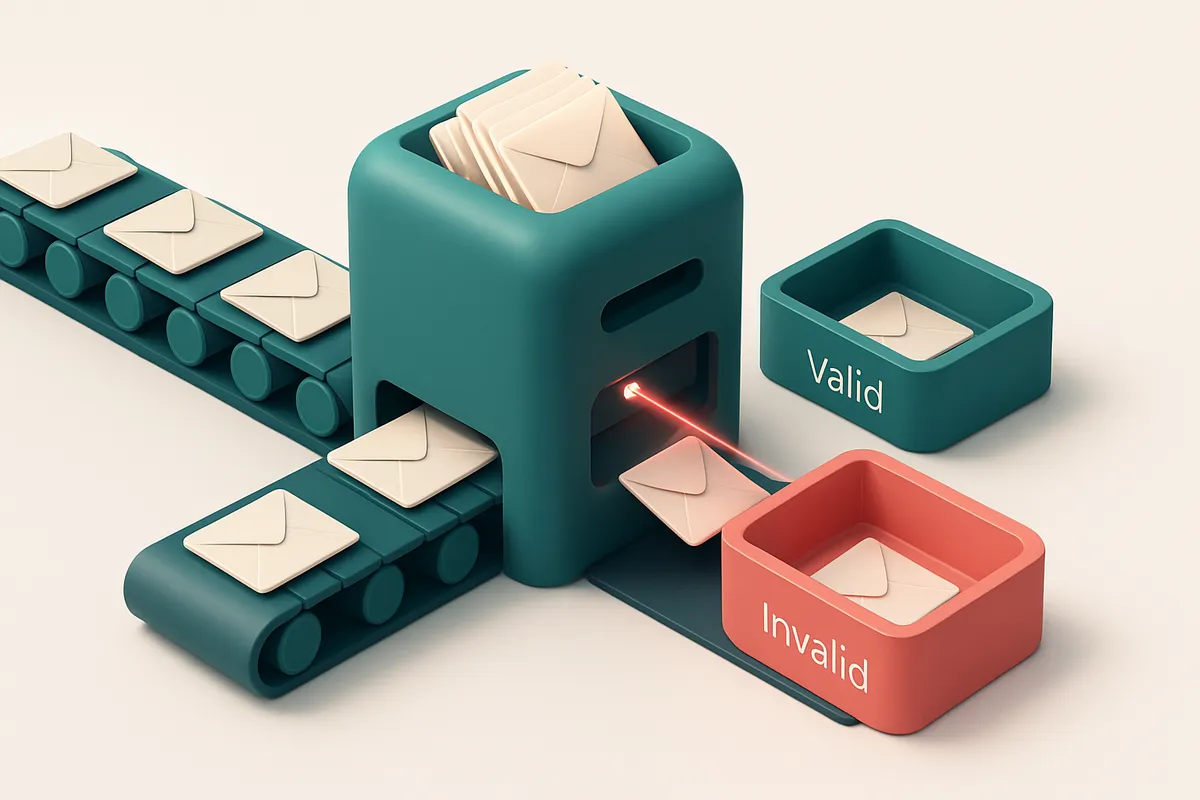
- Each address returns one of four verdicts: valid (inbox-ready), invalid (undeliverable), catch-all (accepts all addresses), or risky (likely fake, disposable, or high bounce risk).
For B2B manufacturers, catching catch-all domains early is key. These accounts can mimic engagement but never deliver real response—let alone sales. And risky emails? They’re a red flag for ISPs and often lead to spam filtering.
Filter for Inbox-Ready Contacts
- Remove all invalid and risky addresses from your campaign list. These don’t belong in any outreach strategy.
- Flag catch-all emails for further validation. You might want to cross-check them via engagement tools or manual follow-up—many are not useful for targeted sales.
- Export only the valid emails. These are confirmed to reach inboxes, which directly improves deliverability rates and sender reputation.
- Use the inbox placement testing feature to simulate your campaign and confirm inbox delivery before sending.
Every month, repeat this process. B2B lists decay. Employees leave. Roles change. Domains go inactive. A list cleaned once won’t stay clean forever.
According to RFC 5321, SMTP servers must reject non-existent addresses during delivery attempts. Let the protocol do the work—for you—by filtering these before they hit your sender pool.
For ongoing campaigns or automated workflows, integrate the real-time verification API. It checks every new address as you add it, maintaining hygiene from day one.
When you verify your list consistently, you’re not just avoiding bounces. You’re building a reputation that ISPs recognize as trustworthy.
What Each Verification Verdict Means for B2B Campaigns
You send emails to prospects, but how do you know if they’ll actually land in their inbox? Each verification result gives you a clearer picture of what’s on the other end. Let’s break down what each verdict means — and why it matters for your B2B manufacturing campaigns.
Understanding the Verdicts
Not all invalid addresses are the same. The same goes for “valid” ones. Here’s what each result really means in practice.
| Verdict | What It Means | Impact on B2B Campaigns | Recommended Action |
|---|---|---|---|
| Valid | The email is active, the domain accepts mail, and the address exists. | High chance of delivery. These are your best targets for outreach and nurturing. | Include in your campaign. No further action needed. |
| Invalid | The address is permanently nonexistent or rejected by the mail server. Common causes: typo, old account, or domain no longer active. | These will generate hard bounces. Bouncing frequently harms sender reputation. | Remove immediately. Keeping invalids in your list weakens deliverability. |
| Catch-all | The domain accepts mail for any address, even non-existent ones. The format is correct, but the recipient may not exist. | High risk of being marked as spam. Many B2B companies avoid catch-alls due to poor engagement and sender reputation signals. | Use with caution. Consider flagging or excluding unless you’re doing a broad outreach where formality outweighs precision. |
| Risky | Indicates a disposable email, role-based address (like info@ or sales@), or known spam trap. Often associated with blacklisted IPs or outdated domains. | Strongly linked to deliverability issues. Sending to these can harm your sender reputation. | Do not send. Remove or avoid unless the address is intentionally for a role-based campaign. |
According to RFC 5321, mail servers must reject invalid addresses early. But catch-alls and disposable domains often slip through — which is why verification isn’t just a cleanup task, it’s a deliverability strategy.
Let’s be honest: a 98.9% accurate verification tool like EmailListChecker won’t tell you everything, but it does flag the biggest threats before they hurt your sender reputation. If your list has a 30% invalid rate, you’re not just wasting sends — you’re risking inbox placement.
Why B2B Manufacturers Should Run Inbox-Placement Tests
You’ve verified your list. Addresses are valid. But here’s the reality: a valid email isn’t the same as an inbox-eligible one. Verification catches typos, invalid domains, and non-existent accounts—but it doesn’t tell you whether your message ends up in the inbox, the spam folder, or gets blocked outright. Let’s be clear: high deliverability means your email lands where it should—right in the customer’s inbox. That’s not something you can assume. It’s something you must test. That’s why inbox-placement testing is not optional for B2B manufacturers with high-value campaigns.
Testing simulates real sending conditions
An inbox-placement test sends a real email from a real IP address to a real inbox across major providers like Gmail, Outlook, and Yahoo. The test tracks where it lands—inbox, spam, or blocked—and gives you actionable data on your campaign’s true delivery status. This is different from just checking syntax. It reveals how your sending reputation, message content, and domain signals are perceived at scale. For manufacturers sending product updates, proposals, or lead gen content, this insight is critical. Major providers use complex filtering systems. These systems evaluate sender reputation, engagement signals, and content patterns. You can’t know how your message stacks up without testing it under real-world conditions.
What these tests reveal about your brand’s sending health
Many brands assume a verified list equals good deliverability. But a high bounce rate or spam complaint ratio can still sink your reputation—even if every email address is real. Inbox-placement tests surface red flags early: high spam placement, sudden delivery drops, or inconsistent results across providers. For B2B manufacturers, where every email represents a sales opportunity, knowing your message lands where it counts reduces wasted effort, improves response rates, and protects sender reputation. The best way to test your deliverability is with a dedicated inbox-placement tool. These tools use real inboxes and simulate actual send conditions across major email providers. If you're building campaigns across Mailchimp, HubSpot, or Klaviyo, integrating inbox-testing into your workflow ensures consistency. You can run tests before sending your list and verify that your messages land in the inbox. A tool like inbox-placement testing from EmailListChecker.io uses real email addresses across Gmail, Outlook, and Yahoo to give you an accurate picture of where your messages land. It’s not about guessing. It’s about knowing. And when you know—your email program becomes more predictable, more trusted, and more effective.
Integrate Verification into Your B2B Workflow (No Coding Needed)
You don’t need a developer to start catching invalid email addresses before they hurt your sender reputation. Let’s build a workflow that plugs into your existing tools—zero code required.
Connect Your Tools, One Click at a Time
- Link Emaillistchecker.io directly to your CRM or email service with native integrations for Mailchimp, HubSpot, Klaviyo, and SendGrid.
- Sync your contact list automatically—no exports, no uploads, no manual scrubbing.
- Keep every new lead clean from day one, without interrupting your sales or marketing process.
Stop Dirty Data at the Source
- Use the real-time verification API to validate emails as they enter your system—on forms, in syncs, or during lead capture.
- Block invalid, typo-ridden, or disposable addresses before they even enter your database. SendGrid’s best practices confirm this is among the most effective ways to maintain inbox placement.
- Integrate the API via simple HTTP calls—no setup headaches, no downtime.
- Use the email finder when a prospect’s address is missing or unverified. It retrieves valid B2B email addresses using the company name and name, reducing lost outreach opportunities.
- Run full list health checks and use the in-app AI assistant to review your list quality. It detects patterns like high disposable domain use, common typo errors, or poor delivery indicators—and suggests precise cleanup steps.
- Check inbox placement for your campaigns with a dedicated test before sending to production lists. This helps you avoid being marked as spam by real inbox providers.
Real-time validation at entry is the most reliable barrier against deliverability issues.
Every time you send to a dirty list, you risk triggering rate limits, being flagged by spam filters, or hitting blocklists. The right tools stop those risks before they start.
With Emaillistchecker.io, you’re not just cleaning data—you’re protecting your sender reputation, saving time, and improving response rates. All without writing a single line of code.
Start with 100 free verifications and see how easily you can integrate clean data into your B2B pipeline: view pricing and get started.
Accuracy That Matters: 98.9% Validation Precision
You send outreach to a list of 5,000 contacts. 400 bounce. 300 are invalid. That’s not a typo—it’s normal if your list hasn’t been verified. But it’s not inevitable.
How Accuracy Translates to Real Results
We use real-time SMTP checks to confirm addresses are active and accepting mail. That means we don’t just check syntax—we talk to the server. If the inbox says “no,” we know before you send.
At the same time, we look at MX records and domain reputation. A domain with a history of spam or abuse? We flag it. A high-risk IP? We catch it. These are not optional checks—they’re standard in email deliverability best practices.
The result? A 98.9% accuracy rate. That number isn’t aspirational. It’s what we measure, track, and verify. You’re not filtering out 98.9% of bad addresses—you’re getting rid of them with near certainty.
That means fewer hard bounces, fewer spam complaints, and fewer sends blocked by inbox providers like Gmail or Outlook. Your sender reputation stays clean. Your list stays sharp.
False Negatives Cost Revenue—Especially in B2B
Here’s where most tools fall short: false negatives. You’ve vetted a list, but you still miss real leads because the system flagged a valid, active address as risky. That’s expensive.
Imagine sending a proposal to a procurement manager at a manufacturer, only to learn your email was never delivered because the address was mis-labeled. That’s not a tech fail—it’s a lost opportunity. And it happens every time your verification tool is too aggressive.
Our 98.9% accuracy cuts both ways: it removes invalid, risky, and disposable addresses while preserving valid leads. That precision is why manufacturers using our bulk verification service see meaningful reductions in bounce rates and higher inbox placement over time.
You don’t need more sends. You need more success per send. And precision is the only way to get there.
For real-time validation at scale, check out our bulk verification or integrate directly via our verification API. Both are designed to work with your existing email workflow—no extra friction.
For deeper insight, you can also test deliverability with our inbox placement test, which simulates how your message lands across major providers. It’s not a guess. It’s data.
SMTP (RFC 5321) and DMARC (RFC 7208) are industry foundations. We validate against those standards—not just surface-level checks.
Start with 100 Free Verifications—Credits Never Expire
Let’s be honest: you don’t want to commit to a tool that locks you in with contracts or disappears after one send. That’s why we start you with 100 free verifications on your first list. No credit card. No trial period. Just plug in your B2B contact list and see exactly what’s valid, risky, or dead before you hit send.
Verify risk-free, then build list health over time
You don’t need to verify every email in a single go. Use the first 100 to clean your current campaign list—trim dead addresses, flag role-based or disposable domains, and catch catch-alls. Then, save the rest of your credits for next quarter’s campaign or use them to gradually verify new leads as they come in. With credits that never expire, you’re not rushing to deploy a list before it’s too late. This approach aligns with how serious B2B manufacturers think about data: systematically, not reactively. It’s the difference between sending to a mail server with 30% bounce rates and one with clean, confirmed, deliverable addresses. Even small drops in bounce rate—say from 12% to 4%—can improve sender reputation over time, which directly affects inbox placement. You can see that impact on your own email provider’s reports. The goal isn’t just to reduce bounces; it’s to build a sendable list that earns trust with providers like Gmail, Outlook, and corporate gateways. This isn’t a feature—it’s a deliverability necessity.
No contracts, no fees—just clean results
You’re not signing up for anything. No forced renewals. No surprise charges. Just a simple, transparent way to keep your list healthy across campaigns. If your list grows over time or you start testing different messaging, those unused credits stay with you. That means you’re not paying for a new tool every six months just to check your list again. And yes, you can automate this. The verification API lets you check new leads as they come in from your CRM or website forms. Integrations with HubSpot, Mailchimp, Klaviyo, and SendGrid mean you can verify before adding a contact to a campaign. That’s not just convenience—it’s insurance against blacklists and reputation damage. If you’re serious about deliverability, start where you can test without risk. Try Emaillistchecker.io’s bulk verification tool with your first 100 emails now—no strings attached. Check your list today.
Conclusion: Clean Lists Are the Foundation of B2B Deliverability
Email verification isn’t a one-time cleanup. It’s a continuous practice that maintains list health and sender reputation over time.
B2B manufacturers who verify their lists before every campaign reduce hard bounces, avoid spam traps, and improve inbox placement—key factors in staying off blacklists.
With Emaillistchecker.io, verification becomes predictable, scalable, and measurable. Every send starts with confidence.
Keep reading
- Deliverability, blocklists and sender reputation (complete guide)
- Email Verification for Improving Sender Reputation in E-commerce
- Email Deliverability Insights for Event Marketing Teams Using Verification Tools
- SaaS Email List Cleaning Tool to Improve Deliverability and Inbox Placement
- Preventing Email Deliverability Issues in Crypto Fundraising Campaigns
Ready to put this into practice? Emaillistchecker.io verifies emails with 98.9% accuracy — start with 100 free verifications.
Frequently asked questions
How does email verification improve deliverability for B2B manufacturers?
It removes invalid, risky, and role-based addresses that trigger spam filters or cause bounces, preserving sender reputation and increasing inbox placement rates.
What percentage of B2B email lists are typically invalid?
Studies show that B2B lists can have 20–30% invalid or outdated addresses, increasing bounce rates and damaging deliverability.
Can I verify emails in real time during lead capture?
Yes—Emaillistchecker.io offers a real-time API that validates addresses at the moment of entry without delaying user experience.
Why are role accounts like info@ a problem for B2B sends?
Role accounts are often flagged by filters because they’re used for high-volume distribution or masked as personal inboxes, increasing spam suspicion.
What’s the difference between a catch-all and a valid email?
A catch-all accepts mail for any address on a domain, meaning the format is correct but the specific user may not exist. Valid emails are active and confirmed by the recipient.
Do disposable emails hurt deliverability?
Yes—disposable domains are often used for spam or fake accounts. Sending to them can trigger spam traps or harm sender reputation.
Can email verification reduce spam complaints?
Indirectly—by cleaning lists of invalid or role-based addresses, you reduce the chance of sending to users who mark your message as spam.
How often should I verify my B2B email list?
Verify at least monthly, or before every major outreach campaign, to maintain list health and avoid deliverability issues.
Does Emaillistchecker.io support bulk verification?
Yes, it supports bulk list verification via CSV upload or direct integration with email platforms like Mailchimp and SendGrid.
Can I use email verification with my existing CRM?
Yes—Emaillistchecker.io integrates with HubSpot, Klaviyo, Mailchimp, and SendGrid, enabling automated list hygiene in your existing workflow.
How accurate is Emaillistchecker.io’s email verification?
It achieves 98.9% accuracy by combining real-time SMTP checks, MX lookups, and domain reputation analysis.
Are purchased verification credits valid forever?
Yes—all purchased credits never expire, letting you use them across campaigns without time pressure.