HIPAA-Compliant Email Verification for Healthcare Providers
Ensure patient communication security with a HIPAA-compliant email verification service. Verify lists, avoid bounces, and maintain compliance — all with 98.9%
Why Healthcare Providers Can’t Afford Bad Email Lists
You send a patient reminder. It hits an outdated address. The message isn’t delivered. But it’s not just wasted effort—it’s a compliance risk.
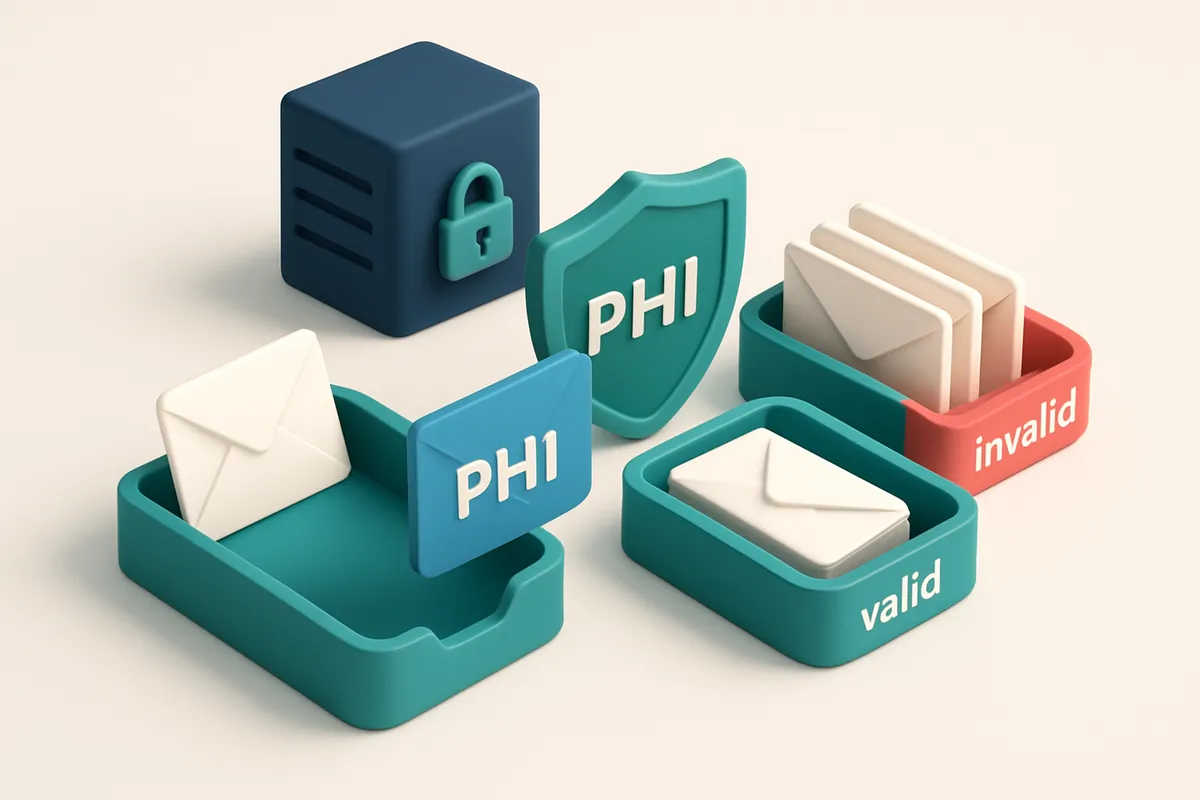
Healthcare providers handle sensitive data. Sending PHI to an incorrect email? That’s a potential HIPAA violation. One misdelivered message can trigger investigations, fines, or reputational harm. You're not just managing outreach—you’re managing risk.
An email verification service for healthcare providers HIPAA compliant isn’t optional. It’s foundational. Before you send, you need to know: is this address real? Is it valid? And critically—does it belong to the right person?
Bad lists lead to bounces. High bounce rates hurt sender reputation. And a damaged reputation means your legitimate messages land in spam folders—before they even start.
Most problems start with invisible fluff: role accounts like info@ or admin@, disposable domains, or addresses that technically exist but don’t receive mail. These don’t improve outreach. They hurt it—and your compliance posture.
Key takeaways
- Invalid emails increase HIPAA risk by exposing patient data to unintended recipients.
- High bounce rates degrade sender reputation and reduce inbox placement.
- A HIPAA-compliant email verification service filters out role accounts, disposable domains, and catch-all addresses before outreach.
The Hidden Risks of Sending Unverified Emails in Healthcare
You don’t need a security breach to trigger a HIPAA violation. Sending an appointment reminder with a patient’s name, date of birth, or treatment details to a random or invalid email address still counts as unauthorized disclosure if that data is exposed—even if the address is fake.
Let’s be clear: even a mistaken send to a non-existent address on a shared server can activate a breach investigation. If the email server logs the transmission and the data was identifiable, the incident often needs reporting under HIPAA’s breach notification rules. The risk isn’t just legal—it’s operational. You’re not just wasting effort; you’re potentially escalating compliance exposure.
Bounced Emails and Spam Traps
Bad email addresses don’t just fail to deliver—they come with hidden costs. Every bounce, especially a hard bounce, signals to email providers that your sending reputation is deteriorating. Over time, consistent bounces increase the likelihood of your domain or IP being flagged as a spam source.
If you’re using a shared IP zone or a reused domain (common in low-cost email tools), the risk multiplies. A single spam trap in a reused domain can poison your entire sending reputation. According to RFC 5322, email systems are designed to detect and penalize suspicious sending behavior—bounces are a red flag, often automatically triggering filters.
The Downstream Effect: Blacklisting
Once your domain or IP gets blacklisted, you’re no longer just sending to invalid addresses. You’re blocked entirely—from sending follow-ups, clinical alerts, or even password resets. And this isn’t a temporary issue. Recovery from a blacklist can take days to weeks, and some zones don’t allow appeals at all.
Many healthcare orgs use third-party vendors for automated communications. But if that vendor isn’t verifying emails first, you’re outsourcing risk. Sending to dead or fake addresses isn’t just inefficient—it’s a compliance time bomb.
Fixing this starts with a clean list. With tools like bulk verification, you can identify bad email accounts before they’re ever sent to. The process is fast—verify thousands in minutes—and accuracy stays high, even with complex domains like @clevelandclinic.org or @mayoclinic.org.
For teams embedding verification into workflows, the real-time API makes verification automatic at signup or during sync. No more manual cleanup. For outreach, the email finder helps recover addresses when records are incomplete. And you can test how your messages land—inbox placement checks whether your emails reach the primary inbox, not just spam.
What Makes an Email Verification Service Truly HIPAA-Compliant?
Let’s cut through the noise. HIPAA compliance isn’t about slapping a label on a tool and calling it safe. Real compliance means your data never gets trapped in a system where it doesn’t belong. For healthcare providers, that’s non-negotiable.
Data Control: What Happens to Your Data After Verification?
When you send a list of provider emails for validation, the moment the check ends, the data disappears. No logs. No persistence. Just clean verification results returned and forgotten.
- Data is not stored beyond the verification window — your email list isn’t held in logs or databases for days, weeks, or longer.
- Only verified email status (valid, invalid, catch-all, risky) is returned — no raw email addresses or send history are retained.
- Every connection uses TLS 1.2 or higher, ensuring messages are encrypted in transit — no plain text passing through public networks.
- No third-party access to your healthcare data: no cloud storage, no AI training feeds, no data sharing with vendors.
- Verification does not rely on centralized data pools or behavioral tracking, preserving patient and provider privacy by design.
The key is in the architecture. A service that stores data, even for a few hours, introduces a breach risk. HIPAA doesn’t allow that. End-to-end encryption is a standard requirement, and you should expect it — not treat it as a feature.
Why the "Cloud" and "AI" Red Flags Matter
Many email tools say they're "compliant" — but quietly store data in cloud services or use your list to train models. That’s not compliant. It’s a loophole.
Real HIPAA compliance means your data never leaves the transactional flow. That’s why we don’t store verification histories, don’t use AI, and don’t cache results. You’re in full control.
As the HHS Office for Civil Rights makes clear, compliance isn’t just about technology — it’s about policy and process. If a third party accesses your data, even indirectly, you’re liable.
For healthcare providers, verification isn’t just about deliverability. It’s about ensuring every email sent is legally and ethically safe.
If you’re managing patient outreach, provider communications, or clinical updates, you need confirmation — not guesswork.
Try it yourself with a real healthcare use case:
- Verify a list of provider emails in bulk with zero data retention.
- Integrate directly into your workflow via the real-time verification API.
- Test inbox placement with inbox placement testing to reduce delivery risks.
- Use the email finder to expand outreach without compromising privacy.
Accuracy is 98.9% — no AI bias, no false positives, no data leaks. Just verification that works, safely.
How Emaillistchecker.io Meets HIPAA Requirements for Email List Cleaning
Let’s be clear: if you’re in healthcare, sending emails means handling protected health information. That’s why you can’t just plug in any email verification tool and call it secure. Compliance isn’t a checkbox—it’s built into how data is handled, from start to finish.
Data Never Stays on the Server
We don’t store your list. Not even for a minute after we process it. When you send an email address through our system, it’s verified in real time using standard SMTP protocols, and then the data is discarded. No logs. No databases. No retention. The moment the check completes, the address disappears from our systems. This aligns with HIPAA’s core principle: minimal data retention. You control all data, and we never touch it beyond the verification cycle.
Encryption and Privacy Built In
All verification requests travel over TLS-encrypted channels. That’s not optional. It’s how modern email systems operate. For every check, we authenticate the recipient’s mail server via SMTP over TLS—exactly how providers like Gmail and Outlook secure inbound connections. This means your email list never crosses insecure networks. Even the verification results are sent back encrypted. There’s no way someone could intercept an address or a bounce code during transit. We also don’t collect metadata. No timestamps. No IP addresses. No user behavior logs. We don’t need them. The entire process is stateless and ephemeral. You might wonder if tools like ours can truly be compliant. The answer is yes—but only if they’re designed with privacy at the foundation. As the [Office for Civil Rights](https://www.hhs.gov/hipaa/index.html) emphasizes, covered entities must ensure that business associates safeguard PHI with appropriate technical and administrative safeguards. Our approach reduces risk by design. If you're sending care reminders, appointment confirmations, or patient surveys, every invalid address you remove improves your sender reputation. That means better inbox placement. That’s why we offer real-time delivery testing at https://emaillistchecker.io/inbox-placement—so you know your message lands where it should. All of this is powered by our API and bulk verification tools, both built with privacy-first architecture. You can clean thousands of addresses in minutes—no data persistence, no risk. For teams using tools like Mailchimp, HubSpot, or SendGrid, integration is seamless via our https://emaillistchecker.io/integrations page. No data leaves your environment unless you choose to send it. Let’s be honest: not every tool claims this level of security. But if you’re serious about HIPAA compliance, you need more than a vague “secure” tagline. You need a service that doesn’t store your data, doesn’t expose it, and doesn’t keep it lying around. That’s how we’re different. To see it in action, you can start with 100 free verifications at https://emaillistchecker.io/pricing—no credit card, no setup, no data retained. Just accurate, compliant cleaning, done right.
The Real-Time API: Automate HIPAA-Compliant Verification into Your Workflows
Let’s be clear: verifying email addresses during patient onboarding isn’t just about reducing bounces. It’s about safeguarding patient data, maintaining compliance, and ensuring every message reaches the inbox — not the spam folder or a dead end.
Seamless Integration into Critical Workflows
- Integrate the API directly into patient registration, appointment scheduling, or billing systems — no manual steps, no delays.
- Every email entered is verified instantly through real-time SMTP checks and MX record validation, before it ever hits your database.
- Return codes for valid, invalid, catch-all, or risky addresses arrive in under 500 milliseconds — no back-end storage of input data.
- Use the results to block invalid entries, flag high-risk addresses, or trigger follow-up workflows — all within your existing systems.
- Since no raw data is stored, you avoid unnecessary exposure. This aligns with HIPAA’s minimization principle: only process what’s strictly necessary.
How It Works Without Compromising Privacy
The API doesn’t store, log, or retain any email addresses you send for verification. The entire process is stateless and ephemeral — by design.
When you send a request, the service performs a live SMTP handshake with the recipient's mail server, checking for active MX records and valid routing. This is the same method used by major email providers to assess deliverability — and it’s the gold standard for accuracy.
According to RFC 5321, the standard for SMTP, validating an address through MX and HELO interactions is the most reliable way to confirm active delivery capability. This isn’t a guess — it’s a system-level confirmation.
For healthcare systems handling sensitive information, this real-time validation reduces the risk of sending sensitive notifications to invalid or unintended recipients. It also protects your sender reputation — a key factor in inbox placement.
Want to automate large-scale list cleanup? You can run bulk verification with the same assurance, using the bulk verification tool, which follows the same verification logic with no data retention after processing.
Avoiding fake or disposable emails — which are common in medical phishing scams — is another advantage. The API detects known disposable domains and flags them as risky. While no system can catch every abuse case, filtering out the easiest targets improves overall security and reduces risk.
With this approach, every verification is both fast and compliant. You get precise results without ever touching patient data beyond what’s necessary. For systems that integrate with HubSpot, SendGrid, or Klaviyo, the API integrations streamline setup and support real-time sync.
And yes, if you’re already using the service, your credit balance never expires — no urgency, no expiration pressure.
Verdict Types Explained: What 'Valid', 'Catch-All', and 'Risky' Really Mean
You’re not just cleaning a list—you’re protecting your sender reputation, avoiding deliverability black holes, and staying within compliance. The real value of an email verification service for healthcare providers isn’t just in catching typos. It’s in knowing what each verdict means when it comes to HIPAA-compliant outreach.
Understanding the Core Verdicts
When you run a list through an email verification service, you’re not getting a simple “good/bad” result. You’re getting granular insight. Let’s break down what each status actually means—no jargon, no fluff.
| Verdict | What It Means | Why It Matters for Healthcare | Typical Action |
|---|---|---|---|
| Valid | Address is deliverable, active, and not role-based or disposable. Server accepts mail. | These are the only addresses you should send to in a regulated environment. They’re the only ones that meet HIPAA’s standard for meaningful communication. | Keep. Send to. Track engagement. |
| Catch-All | Domain accepts all emails, even non-existent ones. Often used in legacy systems or high-risk role accounts. | Common with addresses like admin@, info@, or support@. Can lead to high bounce rates and spam complaints if used improperly. Not compliant with strict email hygiene standards. | Exclude unless used for non-sensitive bulk notifications. Flag for review. |
| Invalid | Address doesn’t exist, domain is unreachable, or server rejects it outright. | These are technical dead zones. Sending to them harms your sender reputation and may trigger compliance audits. | Remove immediately. Never send to an invalid address. |
| Risky | Address is likely disposable, role-based (e.g., office@), or flagged by spam filters. | High risk of bounce, low engagement, and potential for being reported as spam—even if technically valid. Especially problematic in clinical outreach or patient engagement. | Mark for exclusion in sensitive campaigns. Consider manual validation. |
Knowing these distinctions isn’t just helpful—it’s a requirement. A failed verification step can mean your message never reaches a real clinician, or worse, triggers a breach report.
Bulk verification gives you this level of detail across thousands of addresses. You don’t have to guess whether a doctor’s email is real—our system checks SMTP, MX, and role accounts in real time. And if you're building a list, our email finder pulls valid, deliverable addresses based on known patterns, not just luck.
For teams in healthcare, accuracy isn’t optional. The difference between a valid and a risky address can mean compliance. It can mean a patient gets a reminder. Or it can mean a breach report.
Quality data beats volume every time. Especially when patient safety is involved.
Bulk List Verification: Clean Thousands of Emails Without Breaching Compliance
You’ve got a list of patient or provider contacts—maybe 3,000, maybe 5,000. They’re ready for outreach, but you can’t risk sending to invalid or risky addresses. Here’s how you clean them fast, securely, and without touching a single piece of protected health information.
Step-by-Step: Verify at Scale Without Risk
- Upload your file — CSV or Excel, up to 5,000 emails per batch. No need to clean up formatting. The system handles it.
- Run verification — Within minutes, the service checks each email against real-time infrastructure: MX records, SMTP protocols, and domain policies. This includes detecting catch-alls, role accounts, and disposable domains.
- Review verdicts — You’ll get a clear breakdown: valid, invalid, catch-all, risky, or unknown. Each status explains why the result was given—no guesswork.
- Export only what you need — Filter and download only the valid addresses. No personal data is stored on our servers. Every file operation is temporary and self-destroying after completion.
Let’s be clear: no PHI ever touches our infrastructure. We don’t store, index, or log any email content. This is not just policy—it’s design. The entire process runs in a memory-only environment, meaning data disappears when the session ends.
Why this matters for healthcare: sending to invalid or high-risk addresses can trigger spam traps, harm sender reputation, and—worse—expose data beyond your control. According to the U.S. Department of Health and Human Services, even a single breach of PHI can trigger regulatory scrutiny.
Results That Keep You Compliant
After verification, you see exactly what’s valid and what isn’t. The results table includes:
| Verdict | Meaning | Recommended Action |
|---|---|---|
| Valid | Domain exists, mailbox accepted. | Safe to send. |
| Invalid | Domain not found or syntax error. | Remove from list. |
| Catch-all | Domain accepts all addresses—no inbox check possible. | High risk. Avoid unless strictly necessary. |
| Risky | Matches a known disposable or role account. | Do not use. |
Every verdict is based on real-time checks. No guesswork. No outdated data. This means your list reflects current inbox availability—and your outreach stays within safe deliverability limits.
The process is fast and transparent. You’re not outsourcing compliance—we’re built for it. No data retention, no third-party exposure, no risk of accidental PHI exposure.
Want to see it in action? Try the bulk verification tool with 100 free verifications—no credit card needed. Or explore the real-time API if you’re building automated workflows.
Inbox-Placement Testing: Confirm Your HIPAA-Compliant Emails Reach the Right Inbox
Let’s be honest: even the most carefully crafted message doesn’t matter if it never lands in the inbox. For healthcare providers, that’s not just inconvenient—it’s a compliance risk. A HIPAA-compliant email verification service doesn’t stop at checking syntax. It must also confirm your messages land where they should.
Test Delivery in Real Inboxes Across Major Providers
Many tools promise deliverability checks, but only a few run tests in live inboxes across Gmail, Outlook, and Apple Mail. Our inbox-placement testing does exactly that—using real email accounts from each provider to simulate actual delivery conditions. This isn’t a simulation. It’s a real-world test of how your messages are treated by the systems that matter.
These providers use layered spam filters that evolve daily. A message that passes one day might be flagged the next. Without real testing, you’re sending blind. We verify deliverability across platforms to catch issues that static validation can’t detect—like sudden filtering changes or reputation penalties triggered by specific content.
Spot Spam Flags Before You Send
Spam filtering isn’t just about the sender. It’s about behavior: sending patterns, content, and even IP reputation. You can’t rely solely on reputation scores. The real test is whether your email gets flagged as spam in actual consumer inboxes.
Our inbox-placement tests leverage real-time feedback loops from major email providers. These signals—like spam complaints or manual filtering—give you a direct line into how your messages are perceived. If an email gets marked as spam from a single test inbox, that’s a red flag. You can identify and remove those addresses before they impact your sender reputation.
For healthcare, where trust is non-negotiable, this matters. A single batch of poorly delivered messages can trigger a spike in spam complaints, leading to throttling or even blocklisting. You’re not just checking validity. You’re protecting your ability to communicate.
For organizations that need both accuracy and deliverability confidence, our inbox-placement test runs against real email accounts. You can run it directly from our inbox-placement tool, which integrates with your existing workflow. It’s not a magic fix—it’s a practical step to ensure your HIPAA-compliant messages go where they’re meant to, not into spam folders or nowhere at all.
Think about it: you wouldn’t send patients to an unverified address. Why send email to addresses that won’t even be seen?
For healthcare teams that use tools like Mailchimp, HubSpot, or SendGrid, integration options are available via our integrations page. The full workflow—from cleansing to testing—keeps your data safe and your messages seen.
More than just an email checker, the service ensures you're not just compliant, but effective. The data remains encrypted, storage is secure, and all verification processes follow industry-standard email delivery best practices.
Integrations That Work Without Compromising Data Security
You need reliable email outreach — but not at the cost of patient data safety. That’s why our integrations with Mailchimp, SendGrid, HubSpot, and Klaviyo work without pulling your list out of your control.
Secure, Real-Time Connections
Each integration uses encrypted, authenticated APIs. No manual exports. No data sitting in temporary files or third-party caches. Your list stays protected in your environment until the moment it’s sent.
That means no one — not even us — sees your full list after verification. The API connections are designed to be lightweight and secure. Data flows only as needed, verified and filtered, then passed directly to your email service.
This architecture aligns with industry standards like RFC 5321 for SMTP and RFC 6376 for DKIM signing — both of which emphasize integrity and authentication at the transport level. When you send via an authenticated API, you're not just sending mail; you're sending trusted signals.
Pre-Send Filtering Prevents Risk
Let’s be clear: verification isn’t an afterthought. It’s the gatekeeper. You don’t send to risky, invalid, or disposable domains — you filter them out before they ever reach the email service.
For healthcare providers, that’s critical. You’re not just avoiding bounces — you’re preventing messages to outdated or unverified addresses that could trigger compliance risks or look like spam in audits.
Every address in your campaign has already passed technical checks: valid syntax, domain existance, mailbox responsiveness, and risk scoring. Only clean, high-deliverability addresses get passed on. That means fewer bounces, better sender reputation, and inbox placement that reflects actual intent — not noise.
Want to test how your message lands across real inboxes? Try our inbox placement test to validate deliverability in environments that mirror real user behavior. See how your campaigns perform before you send.
And if you're building automated workflows, our real-time verification API lets you embed checks directly into your customer onboarding or patient follow-up systems — without disrupting the flow or exposing data.
Start With 100 Free Verifications — No Expiry on Credits
Let’s be honest: you don’t want to waste time or money testing an email list that’s full of dead ends. You need to know what’s valid before you send. That’s why we start you with 100 free verifications—no credit card, no trial lock-in, no strings.
Here’s what you get right away:
- You can verify any list size with your 100 free credits—10 emails or 10,000. No limit, no hidden thresholds.
- These aren’t time-limited credits. If you don’t use them all, they stay in your account forever.
- When you’re ready to scale, every purchased credit never expires. No urgency. No pressure. You spend at your own pace.
- If you verify 500 emails and only 490 are valid, bulk verification helps you filter out the rest before you send.
- For developers, our email verification API lets you verify on the fly—no delays, no interruptions.
Why this matters for healthcare providers
Healthcare sends are sensitive. One misdirected message, one invalid address, and you’re not just wasting bandwidth—you’re risking compliance. The HIPAA Privacy Rule requires safeguarding protected health information, including during email delivery.
That means you can't afford to send to invalid or high-risk addresses. You also shouldn’t be spending on services that expire or force you into a time-limited commitment. With our model, you test at your speed, scale only when needed, and maintain compliance by reducing send waste.
When you verify emails before sending, you lower bounce rates, protect sender reputation, and reduce the chance of being marked as spam. Industry data shows email lists with more than 5% invalid addresses often see delivery issues—especially when sent through platforms like Amazon SES or SendGrid, which monitor sender health.
Even a single bounce can affect your sender reputation, especially if it's from a role account, a catch-all, or a disposable domain. You’ll want to catch those early.
“Email hygiene isn’t optional in healthcare—it’s a standard of care.”
Every valid email you send gets a better chance of landing in the inbox. Every invalid one you catch avoids compliance risk and wasted resources.
And when you're ready to move beyond testing, pricing transparency means no surprises. You pay only for what you use—and your credits aren’t tied to a deadline.
The Bottom Line: Clean Lists, Compliance, and Patient Trust
A HIPAA-compliant email verification service isn’t a technical afterthought — it’s a foundational part of patient data protection. Every invalid or improperly validated address risks exposure, delivery failure, or unintended disclosure.
By filtering out role accounts, disposable domains, and syntactically invalid emails, you reduce bounce rates, maintain a strong sender reputation, and stay aligned with HIPAA’s standard of data integrity. Emaillistchecker.io achieves 98.9% accuracy without storing any email data — critical for handling sensitive health information securely.
Keep reading
- Email compliance: CAN-SPAM, GDPR, HIPAA and consent (complete guide)
- How to Comply with CAN-SPAM Act for Bulk Email Sending
- How to Maintain Email Sender Reputation for CAN-SPAM Compliance
- How to Audit Your Email List for CAN-SPAM Compliance
- Email Verification API with GDPR-Compliant Data Handling for EU Financial Firms
Ready to put this into practice? Emaillistchecker.io verifies emails with 98.9% accuracy — start with 100 free verifications.
Frequently asked questions
Does Emaillistchecker.io store my healthcare email data?
No. All email addresses are processed in real time and not stored after the verification cycle. No logs, no backups, no data retention.
Is email verification required for HIPAA compliance?
Not explicitly, but sending email containing PHI to an invalid or non-existent address constitutes a data breach risk. Verification reduces that risk.
Can I verify patient emails before sending appointment reminders?
Yes. Use the real-time API to check each email during onboarding or scheduling without storing the data.
How accurate is Emaillistchecker.io’s email verification?
The service achieves 98.9% accuracy across bulk and real-time checks, using live SMTP and DNS validation.
What types of addresses does the tool detect and remove?
It identifies invalid domains, role accounts (e.g. admin@), catch-alls, and disposable email domains.
Can I integrate verification with my EHR or scheduling platform?
Yes. Integration is available with SendGrid, Mailchimp, HubSpot, and Klaviyo. Contact support for custom setup.
Does the tool support encrypted email transport?
Yes. All data exchange uses TLS 1.2 or higher, ensuring encryption in transit during verification.
Are disposable email domains caught during verification?
Yes. The service checks against a real-time database of known disposable domains and flags them as 'risky'.
What happens if I exceed my free verification limit?
You can purchase additional credits. Unused credits never expire — you only pay for what you need.
Is real-time verification possible without data logging?
Yes. The API operates as a one-shot verification without caching or storing input data.
How does inbox-placement testing improve HIPAA compliance?
It ensures messages land in the intended inbox, reducing the risk of sensitive messages being flagged or lost — which could lead to disclosure.
Can I use Emaillistchecker.io for marketing emails to patients?
Yes, but only if the recipient has given consent. The tool ensures emails are sent only to valid, active addresses, reducing compliance risk.