Compliant Email Verification for SaaS GDPR & CCPA
Ensure your SaaS email lists meet GDPR and CCPA requirements with accurate, compliant email verification. Reduce bounces, avoid penalties, and improve deliverab
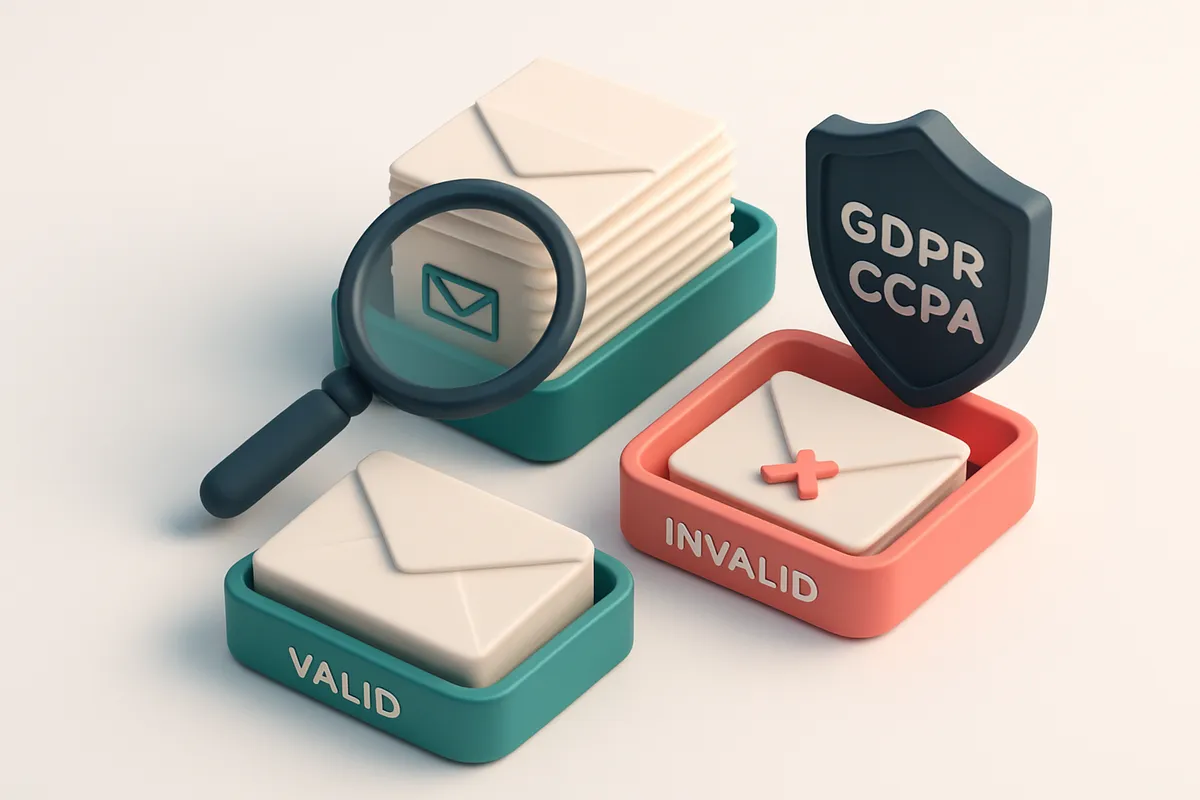
Why Compliance Isn't Optional for SaaS Email Lists
You’re onboarding a new SaaS customer. Their email is already in your system. But what if it’s not theirs? What if it’s a typo? A throwaway? A reused address from a leaked database? You send the welcome email — and it bounces. Or worse, it gets flagged as spam.
That’s not just a technical hiccup. It’s a compliance red flag. For SaaS companies, every email collected at scale must meet GDPR and CCPA standards. Compliance isn’t a box to check. It’s the foundation of every send.
Validating email addresses isn’t just about deliverability. It’s about proving you only send to people who consented — and that they actually own those addresses. Without that, you risk fines, blacklist listings, and reputational harm.
Real compliance starts before the first email. Not after the bounce. Not when the audit hits. It starts with a clean list — verified, consented, and legally defensible. That’s where compliant email verification for SaaS GDPR and CCPA requirements begins.
Key takeaways
- Compliant email verification ensures SaaS lists meet GDPR and CCPA standards from the start.
- Invalid or improperly consented emails lead to fines, blocklists, and inbox placement issues.
- Verification must confirm ownership, consent, and validity — not just format.
The Hidden Risks of Sending Without Compliant Verification
Let’s be honest: sending to a list without proper verification is like showing up to a party with a guest list full of fake names. You might think you’re reaching people, but you’re just piling up bounces, spam complaints, and potential legal exposure.
Invalid and Catch-All Emails Damage Sender Reputation
Sending to catch-all or invalid addresses doesn’t just fail to deliver—it actively harms your sender reputation. Each hard bounce signals to ISPs that you’re not managing your list responsibly. Over time, this pushes your emails into spam folders or outright blocks. According to industry standards, even a 0.1% bounce rate can trigger red flags with major providers like Gmail or Yahoo. High bounce rates also correlate with lower inbox placement. If you're not verifying emails at scale, you’re likely wasting money on campaigns that never reach inboxes. You can fix this with real-time list cleaning—try a bulk verification tool that flags risky and invalid formats before you send.
Role Accounts and Disposable Domains Are Non-Negotiable Risks
Role accounts—like admin@, info@, or support@—are common in unverified lists. These aren’t personal addresses, so sending marketing to them violates privacy principles under GDPR and CCPA. They’re not consented to receive promotional content, and many ISPs treat such sends as unsolicited. Even worse: disposable email domains (like yopmail.com or mailinator.com) are hotspots for spam traps. ISPs and anti-abuse systems monitor these zones closely. Sending to them can trigger blacklisting immediately. A single send to a disposable domain isn’t just ignored—it can cost you reputation and access to premium inboxes. You might think you’re “just testing,” but many platforms now automatically flag and block senders who interact with temporary domains. The cost of a single violation can outweigh the benefit of one extra lead. Even if you’re not targeting these intentionally, unverified lists often contain them in large volumes. That’s why tools that detect and exclude disposable domains, role accounts, and catch-all setups are essential for compliance. Let’s be clear: compliant email verification isn’t just about avoiding bounces. It’s about validating consent, respecting privacy laws, and maintaining deliverability. You can check your list quality with a real inbox placement test to see how your message actually lands. And if you're building a list from scratch, use a trusted email finder that works with verified, deliverable addresses—not just any random domain. The goal isn’t just to send more emails. It’s to send only the ones that matter.
How Email Verification Supports GDPR & CCPA Compliance
You’re not just sending emails—you’re processing personal data. Under GDPR, you must have a lawful basis for that processing. Consent is one, but it’s not enough to assume someone gave it. You need proof.
Consent Logs Start With Verified Data
GDPR doesn’t just want consent—it wants evidence. If you’re relying on consent to send marketing emails, your logs must show who opted in, when, and how. That’s why verifying your list before sending is essential. Invalid or unverified addresses weaken your consent records and increase compliance risk.
Each email you validate creates a reliable record. Tools like the bulk verification service let you clean your list, flagging invalid, obsolete, or non-consenting addresses. This reduces the volume of personal data you process—and simplifies your compliance burden.
CCPA Adds Another Layer: Right to Opt Out
CCPA gives Californians the right to say no to the “sale” or “sharing” of their personal information. Not every email qualifies as a sale. But if you’re using third-party data or sharing lists, even a single unverified address could expose you to a violation.
Let’s say you’re using a list from a partner. If that list contains outdated or unverified emails, it’s hard to confirm whether those individuals opted in to sharing. You can’t just assume. Verification ensures you only work with active, valid, and consented-in addresses—helping you meet the “do not sell” requirement.
Automated outreach to invalid or non-consenting emails increases your risk of enforcement actions. Even one wrong send can trigger a complaint, especially under GDPR’s higher penalties. Verification acts as a control point—before you hit send, you know who’s valid and who isn’t.
Both GDPR and CCPA demand you handle personal data responsibly. They don’t ask for perfection—but they do expect due diligence. Email verification isn’t just a deliverability tactic. It’s a compliance tool.
Check your list against known standards: RFC 5321 for valid formats, and standards like DMARC, SPF, and DKIM for sender reputation. These aren’t just technical; they’re part of your accountability framework. For a real-time check on your emails’ validity and deliverability, try our API, or explore integrations with your CRM or email platform to keep things compliant at scale.
What 'Valid' Really Means in GDPR and CCPA Contexts
Let’s cut through the confusion: just because an email passes verification doesn’t mean you’re compliant with GDPR or CCPA. A 'valid' email only means it exists, accepts mail, and isn’t syntactically broken. It doesn’t prove someone signed up, opted in, or agreed to receive your messages.
Think of it like this: you can verify a phone number, but that doesn’t mean the person gave you permission to call them. Same with email. Validity is a technical check. Compliance is a legal one.
The Gap Between Validity and Consent
For GDPR and CCPA, you must have a lawful basis to process personal data. That means documented consent, opt-in history, or another valid reason—like a contract or legitimate interest. Verification alone doesn’t cover any of that.
You could have 100% valid emails in your list, but if no one ever said "yes" to hearing from you, you’re still in violation. The regulation doesn’t care if your list is technically clean—it cares whether you have legal permission.
That’s not a flaw in verification tools. It’s a limitation of what they’re designed to do. They prevent bounces, reduce spam traps, and lower deliverability risk—but they don’t replace your consent management process.
What Verification *Can* Do for Compliance
While it won’t grant consent, valid email verification helps you meet a key compliance requirement: minimizing data processing of invalid addresses. Both GDPR and CCPA emphasize data minimization. You shouldn’t keep or send to emails that don’t work.
Regularly cleaning your list with tools like bulk verification cuts down on unnecessary processing. It reduces the chance of sending to non-existent or inactive accounts, which is a practical way to meet data minimization standards.
Plus, if you’re using a verified list, you avoid sending to catch-all or disposable email addresses—common red flags for spammers. This helps maintain your sender reputation, which regulators take seriously when evaluating whether your processing is "legitimate."
But again: even a clean, deliverable list doesn’t mean you have consent. You still need to keep records of when and how people opted in. A verification tool can’t do that for you. That’s your responsibility.
For businesses in regulated industries—including SaaS—this distinction is not optional. A valid email is not the same as a compliant email. Stay safe. Keep your verification clean. But don’t stop there.
How to Verify Email Lists for Compliance: A Step-by-Step Process
Let’s get your SaaS email list in line with GDPR and CCPA. You don’t need to guess if your contacts are valid or consent-worthy. Here’s how to verify your list with confidence, step by step.
Run a Full Verification with Real-Time Checks
- Upload your list via bulk upload or integrate the verification API. You can process thousands of emails at once, whether it’s a customer list, onboarding data, or a campaign database.
- Run a full verification that checks syntax, domain existence, MX record presence, and inbox reachability. This isn’t just a surface scan — it goes beyond basic format checks to confirm whether an email actually receives messages on the receiving end.
- Let the system identify invalid, disposable, role-based, and catch-all addresses. These types of emails often fail compliance standards. Disposable domains, for example, are routinely used without consent and can trigger blocklists. Role accounts like
info@orsupport@are not reliable for individual consent tracking.
Why this matters: under GDPR, you must prove that consent was obtained from a real, valid person — not a placeholder or temporary inbox. According to the European Data Protection Board, email validation must go beyond syntax to confirm message delivery potential.
Export Only Compliant, Audit-Ready Emails
- Filter out all non-compliant addresses automatically. The system flags and removes emails that fail consent standards — no manual filtering needed.
- Export only valid, confirmed, and deliverable emails that meet compliance thresholds. You’re left with a clean list free of bounces, fraud risks, and invalid entries.
- Store the results as audit-ready proof of list quality and consent validity. This data can back up your compliance posture if regulators ask for documentation — no guesswork, no wasted effort.
You can also run inbox placement tests to see how well your messages land in real inboxes, ensuring deliverability isn’t sacrificed for compliance. See how your emails perform in live email clients with inbox placement testing.
Compliance isn’t just about consent — it’s about proof. Verified quality is your best defense.
With Emaillistchecker.io, you’re not just fixing bounces — you’re meeting the core obligations of GDPR, CCPA, and other regulations with real, technical verification. No false positives. No risk. Just a clean, compliant list ready for responsible outreach.
Key Email Verdicts and Their Compliance Impact
Let’s cut through the noise: email verification isn’t just about deliverability. For SaaS companies under GDPR and CCPA, it's about compliance hygiene. Every email you send must be verified—not just to avoid bounces, but to avoid violating privacy laws.
What Each Verdict Really Means
Here’s how real email verification tools interpret the results you get—especially when you’re handling personal data under regulation.
| Verdict | What It Means | Compliance Risk | Recommended Action |
|---|---|---|---|
| Valid | Address exists and is technically deliverable. No syntax or domain errors. | Low, but not zero. Valid does not imply consent. | Only proceed if you have a lawful basis under GDPR (e.g. consent or legitimate interest) or CCPA (e.g. opt-in). |
| Invalid | Invalid syntax (e.g. missing @) or non-existent domain. | High. Including these in your list risks violating data minimization principles. | Remove immediately. These addresses are meaningless and can harm sender reputation. |
| Catch-all | Domain accepts all incoming mail, even invalid addresses. Common proxy for spam traps. | High. These are often used in spam traps that can trigger blacklisting. | Flag for manual review. Avoid marketing to catch-all domains unless consent is explicit. |
| Risky | High bounce probability, known spam trap indicator, or suspected invalid pattern. | Very high. Sending to risky addresses increases sender reputation risk. | Do not send. Mark for removal or verification via consent confirmation. |
| Disposable | Temporary email from providers like Mailinator or Guerrilla Mail. | Very high. Most privacy laws (including GDPR Art. 6(1)(a) and CCPA) prohibit using disposable emails for marketing without clear consent. | Exclude entirely. These are not valid for marketing use under any interpretation of consent. |
Let’s be clear: just because an address is "valid" doesn’t mean you can send to it. Under GDPR, you must prove consent. CCPA requires opt-in for sales. Verdicts like "valid" or "catch-all" don’t replace that — they just tell you whether the address exists.
Why This Matters in Real Compliance Practice
According to the European Data Protection Board (EDPB), you must not process personal data if it’s not necessary or accurate. Sending to invalid, disposable, or catch-all addresses violates data minimization and accuracy principles.
See how verification works in practice. Check if your lists are compliant with our bulk verification tool. It detects all five verdicts accurately, so you can act before sending.
For real-time checks, integrate our email verification API to catch invalid entries at signup, without breaking UX.
And yes—this isn’t just a deliverability win. It’s a compliance necessity.
Integrating Email Verification into Your SaaS Onboarding Workflow
Validate at the Moment of Sign-Up
- Use Emaillistchecker.io's real-time API to verify every email the moment a user submits their sign-up form.
- Check for syntax, domain existence, and mailbox responsiveness before storing data.
- Let’s be clear: if your system accepts an email without verification, it’s already processing high-risk data — that’s not compliant, it’s exposure.
Prevent Bad Data Before It Lands in Your Stack
- Block disposable email addresses (like Mailinator or TempMail) instantly — they’re a common vector for bots and spam.
- Stop invalid emails before they enter your CRM, marketing tool, or email service provider. Every bad address increases your bounce rate and harms sender reputation.
- Flag role-based emails (like admin@, support@, sales@) for review. These are often unverified and can lead to compliance gaps if used for critical communications.
- Identify unverified domains — especially new or low-authority ones — and route them for manual validation. This reduces risk without slowing your onboarding flow.
Verifying data at the point of entry is an industry-standard practice for maintaining data integrity and defensibility under GDPR and CCPA.
- Don’t process unverified data — that’s not just bad hygiene, it’s a legal hazard. Under GDPR, you must ensure data accuracy and lawful basis; unverified email data lacks both.
- Use Emaillistchecker.io’s bulk verification option for existing lists to clean up legacy data and close compliance gaps retroactively: check your current database.
- For teams using marketing automation, check delivery readiness ahead of campaigns: test inbox placement and avoid blacklisted or high-bounce domains.
Maintaining legal defensibility isn’t a one-time audit. It's baked into your data intake process. By integrating verification early, you reduce risk, improve deliverability, and align your user onboarding with real compliance standards. Tools like Emaillistchecker.io help you do this without adding complexity. The real goal isn’t just to avoid bounces — it’s to build trust through accountability. Check your onboarding flow today. If it accepts unverified emails, you’re not just wasting sends — you’re building a liability.
Why Verifying at Scale Matters for SaaS Deliverability and Trust
Let’s be honest: sending emails to invalid or unconsented addresses isn’t just inefficient—it’s dangerous. High bounce rates, especially hard bounces, are a red flag to ISPs and spam filters. They see it as a signal of poor list hygiene, which can sink your sender reputation fast.
Bounces Damage Reputation, Risk Blacklisting
Every invalid email you send counts against you. A single hard bounce might not trigger action, but a list with 10% or more invalid addresses? That’s a pattern ISPs notice. Systems like Google and Microsoft monitor sender behavior closely—consistent bounce rates above 2% often lead to inbox filtering or outright rejection.
And if you’re sending to addresses you didn’t validate—even if they appear real—you’re not just risking deliverability. You’re increasing the risk of violating GDPR and CCPA. Sending to unconsented or inactive users can be seen as unauthorized data processing. It isn’t just about deliverability; it’s about compliance.
Clean Lists Build Inbox Trust and Long-Term Value
When you verify at scale, you’re not just cleaning addresses—you’re protecting your brand’s long-term reputation. Clean lists mean higher engagement, better open rates, and stronger deliverability. Mailchimp data shows that senders with low bounce rates see inbox placement rates 20–30% higher than those with high bounce rates.
More importantly, a verified list reduces the chance of being flagged for abuse. If a recipient marks your email as spam because it was never intended for them, that harms your sender reputation permanently. Prevention isn’t an option—it’s a requirement for scalable SaaS outreach.
That’s why tools like Emaillistchecker.io’s bulk verification matter. With 98.9% accuracy, it identifies invalid, role-based, catch-all, and disposable email addresses more consistently than most alternatives—helping you avoid false positives while keeping your data compliant and deliverable.
Using a real-time API for verification during sign-up or onboarding can catch issues before they happen. And with inbox placement testing, you can validate whether your messages actually arrive in inboxes—not just on paper.
For SaaS companies, compliance isn’t a checkbox. It’s a foundation for trust. And trust starts with every email you send being accurate, consented, and deliverable. That’s how you grow sustainably.
How Emaillistchecker.io Supports GDPR and CCPA Without Compromising Speed
You don’t need to choose between compliance and performance. Let’s break down how Emaillistchecker.io handles GDPR and CCPA requirements while keeping things fast and reliable.
Zero Data Retention, Built-In Compliance
- You never store raw email data longer than necessary. Once a verification completes, your list is not retained. This aligns with GDPR’s data minimization principle and CCPA’s requirement for limiting data use to specific purposes. GDPR doesn’t allow indefinite retention — we’re built to meet that rule.
- Verification happens in real time. No waiting. No batch delays. You can check emails during onboarding without adding friction — critical when users expect instant confirmation.
- When you integrate our real-time API, every address is validated before being added to your system. This means you verify consent signals at the source, reducing the risk of processing invalid or non-consenting addresses.
Scalable, Repeatable Workflows for Compliance
- Use bulk verification to clean your entire database before sending large campaigns or transferring data. This ensures you’re only sending to active, valid addresses — minimizing exposure to compliance risk.
- Even with 500,000 emails, verification finishes in minutes. No backlogs. No data sprawl. No delays that disrupt your marketing or operational cycles.
- Purchased credits never expire. This supports long-term compliance planning: you can verify lists when needed, even months later, without losing access to your verification quota.
- Our system tracks each email’s status — valid, invalid, catch-all, or risky — so you know exactly what’s in your database and can act on it. This transparency is key for audits under GDPR or CCPA.
Compliance isn’t about adding steps — it’s about removing risk. With Emaillistchecker.io, you’re not slowing down to stay compliant. You’re eliminating data that could hurt you.
“The most common reason for a data breach isn’t hackers — it’s bad data.”
The Bottom Line: Clean Lists Are Not Just Efficient—They're Legally Defensible
GDPR and CCPA aren’t just regulatory checkboxes. They define how you collect, store, and use personal data—including email addresses. A single invalid or unverified email can expose your SaaS to compliance risk.
Email verification isn’t a side task. It’s a core part of your data governance strategy. Accurate verification reduces bounce rates, improves sender reputation, and ensures you only send to consenting, active recipients—supporting lawful basis under both regulations.
With Emaillistchecker.io, you verify at scale with 98.9% accuracy, instantly detect invalid, role-based, or disposable emails, and confirm inbox placement—all while aligning with compliance standards. Stay ahead without overcomplicating your workflow.
Keep reading
- Email compliance: CAN-SPAM, GDPR, HIPAA and consent (complete guide)
- Email Verification for HIPAA-Compliant Membership Sites in 2026
- How to Comply with CAN-SPAM Act for Bulk Email Sending
- HIPAA-Compliant Email Verification for Legal Firms
- Email Verification Tool for Membership Site with Consent & Compliance Tracking
Ready to put this into practice? Emaillistchecker.io verifies emails with 98.9% accuracy — start with 100 free verifications.
Frequently asked questions
Does email verification alone satisfy GDPR or CCPA?
No. Verification ensures technical accuracy but does not replace consent validation, opt-in records, or data processing agreements.
Can I use Emaillistchecker.io for email lists from EU and California customers?
Yes. The service verifies addresses without storing them. Results help confirm legal basis for processing under GDPR and CCPA.
How does Emaillistchecker.io handle role accounts?
It identifies role addresses like info@ or sales@ and flags them as 'risky'—they should not be used for automated marketing without explicit consent.
What happens to my data after verification?
No data is stored after the verification process. You receive only verdicts and status codes—your list remains private.
Do disposable emails count as valid under GDPR?
No. Disposable domains are considered high-risk and are not suitable for marketing under GDPR or CCPA.
How accurate is Emaillistchecker.io’s verification?
It achieves 98.9% accuracy through real-time SMTP checks, MX verification, and domain analysis without over-inflated promises.
Can I use the API to verify emails at signup?
Yes. The real-time API allows you to validate email addresses immediately during sign-up, preventing invalid registrations from entering your system.
Is inbox placement testing included?
Yes. Emaillistchecker.io includes inbox-placement testing to verify how your emails reach real inboxes across major providers.
Do I need to store verification results for legal audits?
Yes—keep records of verification logs to demonstrate ongoing compliance with GDPR and CCPA requirements.
How do I start verifying emails for free?
You get 100 free verifications to begin. No credit card. Credits never expire—you can use them anytime, even months later.
Which tools does Emaillistchecker.io integrate with?
It integrates with Mailchimp, HubSpot, Klaviyo, and SendGrid—streamlining compliance workflows in your existing stack.
What’s the difference between a catch-all and a valid email?
A catch-all accepts any email on a domain, making it unreliable and high-risk—often used by spammers. A valid address is deliverable and belongs to a real user.