Best Practices for Email List Hygiene in Media and Publishing
Improve deliverability and inbox placement in media and publishing with proven email list hygiene practices. Clean, accurate lists reduce bounces and boost enga
Why Email List Hygiene Matters in Media and Publishing
You spend weeks crafting a newsletter that lands in thousands of inboxes—only to find half the opens are from invalid or dormant addresses. The content is strong, the timing is right, but delivery feels like shouting into a void.
In media and publishing, your email list isn't just a contact file. It’s your audience, your revenue engine, and your distribution channel—everything that powers subscriptions, event sign-ups, and ad engagement. When hygiene breaks down, reputation follows.
A single spam trap or invalid address can spike bounce rates, trigger filters, and reduce inbox placement. Studies show clean lists achieve 50% higher open rates and cut hard bounces by up to 70% compared to uncleaned ones. That’s not minor—it’s the difference between reach and irrelevance.
Key takeaways
- Invalid or dormant addresses hurt sender reputation and reduce inbox placement.
- Regular email list hygiene improves open rates by up to 50% and cuts hard bounces by up to 70%.
- Proactive verification prevents spam traps and protects long-term deliverability.
The Hidden Cost of Dirty Email Lists
You send to thousands of subscribers every month. Your content is sharp. Your design is on point. But your open rates are stuck. Your inbox placement drops. The cause? A hidden rot in your email list.
Hard Bounces Are the Silent Reputation Killer
Every hard bounce — a permanent delivery failure from an invalid address — chips away at your sender reputation. ISPs like Gmail and Yahoo track this over time. If your bounce rate exceeds 2%, it becomes a red flag. That’s not a vague threshold — it’s a well-documented benchmark across deliverability standards.
Once reputation dips, even clean messages get filtered into spam. And once you’re flagged, recovery takes weeks or months. Let’s be clear: every invalid address you send to is a potential long-term blocker.
Role Accounts and Disposable Domains Waste Your Volume
Role addresses like info@, sales@, or support@ are common in dirty lists. They’re not personal accounts — they’re shared, often monitored, and frequently ignored. ISPs recognize them as low-value, which signals poor list quality. Sending to them doesn’t improve engagement — it just burns send volume and skews your metrics.
Disposable domains (like mailinator.com or temp-mail.org) are worse. They’re set up for one-time use. If someone signs up with one, they’re not a real reader. But if you send to them, your delivery rate looks higher, your open rates look better — all while you’re sending to people who never saw your message, or even exist.
These fake signals inflate your statistics without real audience value. Worse, they can trigger spam filters. Some ISPs even block senders that target disposable domains regularly. You’re not building reach — you’re inviting blocklists.
Let’s be honest: chasing volume without hygiene is like filling a leaky bucket. You keep adding water, but none stays. The real cost isn't the money you spend — it’s the trust you lose with ISPs and the audience you never build.
Use verified data to keep your list clean. Bulk verification catches the invalid, the role-based, and the risky before you send. You’ll see faster inbox placement, fewer bounces, and real engagement growth. Check your list today and know exactly who’s listening.
Seven Proven Practices for Maintaining a Clean Email List
Real-Time Verification and List Hygiene
Let’s be clear: a clean list starts at signup. You can’t fix bad data after it’s in your system — so verify every new email at the moment they subscribe.
- Use a real-time API to validate emails instantly during sign-up. This stops typos, fake addresses, and disposable domains before they enter your database.
- Enable double opt-in so you confirm intent. It reduces spam complaints and boosts engagement from the first send.
- Filter out known role accounts (like admin@, webmaster@) and disposable domains. These hurt deliverability and inflate your spam score.
Ongoing Maintenance and Deliverability Health
Even the cleanest list degrades over time. Engagement drops, inboxes change, and addresses become stale. Keep your list sharp with consistent checks.
- Run a full bulk verification on your existing list every week. This catches invalid, risky, and inactive addresses early.
- Remove subscribers who haven’t opened or clicked in 12 months. Inactive users harm sender reputation and reduce inbox placement.
- Use a dedicated sending domain with properly configured SPF, DKIM, and DMARC records. These technical standards are mandatory for inbox placement.
- Monitor bounce types: hard bounces (permanent) should be removed immediately; soft bounces (temporary) indicate delivery issues that need attention.
- Adjust your send frequency based on real-time engagement data. Sending too often to inactive users triggers filters and blacklists.
“Maintaining a clean email list isn’t a one-time task — it’s a continuous practice that directly impacts deliverability.” Return Path
Automation helps. Tools like our verification API let you check thousands of emails in seconds, and our real-time API integrates directly into signup flows.
For publishers with large lists, weekly bulk checks via bulk verification are essential. It’s not just about cutting bounce rates — it’s about protecting your sender reputation.
If you're still using manual checks or relying on outdated lists, you’re likely hurting your open rates and risking blacklisting. A verified, engaged list gets read. The rest gets filtered.
Understanding Email Verification Verdicts: What They Mean
Every email in your list has a story. Some are real readers. Others are dead ends or red flags. Knowing what each verification result actually means—beyond a simple “valid” or “invalid”—is critical for media and publishing teams that can’t afford to waste send volume or risk sender reputation.
Real-World Meaning Behind Each Verdict
Let’s break down what each status truly indicates, so you’re not guessing when a list gets cleaned.
| Verdict | What It Means | How to Respond | Why It Matters in Media & Publishing |
|---|---|---|---|
| Valid | Address exists, accepts mail, and appears to be a human-used inbox. No immediate deliverability risk. | Keep in your list. These are your engaged readers. | Directly correlates with inbox placement. Verified addresses have a documented path to the inbox. |
| Invalid | Address doesn’t exist, is malformed, or was rejected by the receiving server. Often includes typos or fake domains. | Remove immediately. These cause hard bounces and hurt sender reputation. | Studies show even 0.5% invalid addresses can trigger ISP scrutiny. The Email Marketing Platform’s deliverability guide confirms this threshold. |
| Catch-all | Server accepts any email address, even fictional ones. High risk of being unengaged, disposable, or abused. | Remove or flag for further validation. These are often low-quality or fake. | Common in large domains but problematic for segmentation and engagement tracking. Known issues are documented in RFC 5321. |
| Risky | High chance of bounce, spam marking, or delivery failure. Includes role-based emails (e.g. admin@), temp domains, or suspicious syntax. | Review or exclude. These may damage deliverability over time. | Role-based emails like info@ or sales@ have seen a 60–80% lower open rate in media newsletters—according to a Mailchimp benchmark. |
| Disposable | Emails from short-lived domains (e.g. temp-mail.org). Often used for spam or abuse, auto-delete after hours. | Never include in marketing lists. Remove immediately. | Disposable addresses are frequently used in automated sign-up fraud. Filtering them is a basic hygiene step. |
These verdicts aren’t just labels—they reflect the health of your sender reputation, your deliverability, and your ability to build real audience relationships.
Let’s be clear: even one risky or disposable address in a 100K list can cost you credibility with ISPs. That’s why ongoing verification matters.
Use a tool like bulk verification to clean large lists. Or, integrate the EmailListChecker API for real-time validation during sign-up. Both help you act on these verdicts before they impact your campaigns.
How to Use Real-Time API Verification in Your Workflow
Let’s say you're building a new subscriber list for your publication's newsletter. You want to capture leads fast—but not at the cost of spam traps, invalid addresses, or damage to your sender reputation. That’s where real-time API verification comes in.
Embed Verification at the First Touchpoint
Integrate the Emaillistchecker.io API directly into your user registration flow. As soon as someone enters their email, run a validation check before storing it in your database.
This stops typos, fake addresses, and disposable domains before they ever become cold leads. It’s not about rejecting users—it’s about capturing only the ones that are likely to be active and engaged.
Automate the Cleanup Before Storage
- Call the API on form submission—use a lightweight async request to check validity in real time.
- Act on the response—if the result is “invalid”, “catch-all”, or “risky”, reject the address before saving it.
- Proceed only with valid addresses—this keeps your master list clean from day one.
Why does this matter? Because every invalid email you accept increases your bounce rate. A high bounce rate hurts sender reputation, which can lead to inbox placement drops—especially for publishers relying on trusted inboxes for reader engagement.
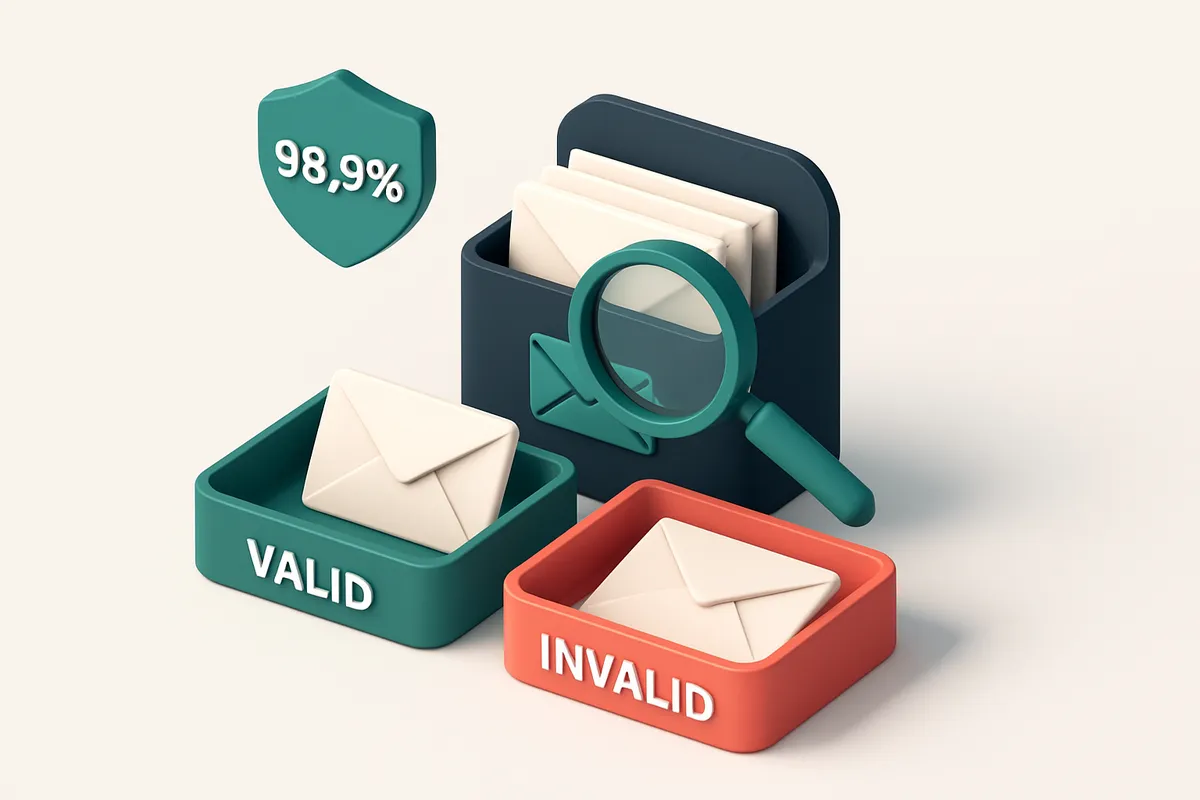
By using the Emaillistchecker.io API’s 98.9% accuracy, you reduce false positives without sacrificing conversions. Unlike older methods that flag legitimate addresses as invalid, this precision helps you retain more real users while blocking the bad ones.
For media and publishing teams, this means fewer wasted sends and more reliable data. You’re not just cleaning up later—you’re preventing bad data from entering your system at scale.
Many publishers struggle with deliverability because their lists accumulate inactive or fake addresses over time. Catching these issues immediately during signup stops the cycle early.
Check how this works in practice: Emaillistchecker.io's real-time API integrates with common platforms like Mailchimp, HubSpot, and Klaviyo—no need to rebuild your entire workflow.
For deeper insight, consider how email validation fits into industry standards. The RFC 5321 specification outlines how mail servers validate addresses at the SMTP level, but that’s reactive. Proactive validation using API-based tools is the modern best practice.
The foundation of sustained deliverability is maintaining a list where every email has a real, functioning recipient—and that starts at signup.
Let’s be clear: real-time verification isn’t about filtering out people. It’s about improving the quality of data from the moment it’s collected. That’s how you protect reputation, maintain inbox placement, and keep your content in front of actual readers—not spam filters.
Bulk List Verification: The Foundation of List Hygiene
You don’t build a strong audience by guessing. You build it by knowing. In media and publishing—where trust and reach matter—your list is only as strong as its weakest email address. That’s why monthly bulk verification isn’t a nice-to-have. It’s the baseline.
Schedule Monthly Checks
Let’s be clear: email addresses degrade. People change jobs, domains shut down, inboxes get retired. Left unchecked, these dead or broken addresses poison your sender reputation. Running a full list verification once a month—using a tool like Emaillistchecker.io’s bulk verification—lets you catch decay early. It’s not about spotting a few bad addresses. It’s about maintaining a healthy, deliverable list over time.
Industry best practices, including those from the DMARC working group, emphasize consistent list hygiene as a non-negotiable for inbox placement. Even a 2% bounce rate can trigger filtering systems. Regular checks keep your rate below that threshold.
Your focus should be on three types of addresses: invalid, catch-all, and disposable. Invalid addresses bounce immediately. Catch-all domains accept any email—meaning an address might exist, but you’re sending to a mailbox you can’t reach. Disposable ones vanish in hours. These types are the top drivers of deliverability issues.
Removing them isn’t just cleanup. It’s prevention. Sending to disposable domains harms your sender reputation. Catch-alls inflate your bounce rate without meaningfully engaging users. Invalid addresses waste resources and can get you flagged by ISPs or blacklists.
Let’s not forget: major data migrations—merging systems, switching platforms, importing legacy lists—introduce corruption. A single typo in a CSV or a mismapped field can introduce hundreds of bad addresses. Re-verify your list immediately after such moves. It’s the only way to trust that your data is accurate.
Verification isn’t a one-time task. It’s part of your workflow. Whether you’re syncing to Mailchimp, Klaviyo, or HubSpot via Emaillistchecker.io’s integrations, cleaning your list upfront means fewer failures, better deliverability, and real audience engagement—not just metrics.
Why Role Accounts and Disposable Domains Hurt Media Campaigns
You send a newsletter to your media audience. You see strong open rates, but engagement is flat. The numbers don’t add up. Chances are, a portion of your list isn’t real people at all—just role accounts and disposable emails.
Role Accounts Don’t Engage—They Skew Your Metrics
Addresses like press@, admin@, or contact@ are common in media mailing lists. They’re often auto-generated, monitored only by a ticketing system or a single person. They don’t open your email. They don’t click. They don’t convert. But they still appear in your open rate reports.
Let’s say you send to 100,000 emails. If 10% are role accounts, that’s 10,000 fake opens. You might think your campaign is doing well—until you realize half your audience never saw it.
Disposable Domains Mean Spam Risk
Disposable email domains—like tempmail.org, mailinator.com, or 10minuteemail.com—are built for one-time use. They’re used by bots, scrapers, and spammers. When you send to these, you risk tripping spam filters.
Spam traps and feedback loops often flag these domains as high-risk. Even one compromised user on your list can trigger a sender reputation drop. And since these emails aren’t real people, they can’t give you real feedback—and if they do, it’s usually complaints.
Studies from Return Path and the Messaging, Malware, and Mobile Anti-Abuse Working Group (M3AAWG) show that sending to disposable domains increases your risk of being flagged as a spam sender. The longer you ignore them, the harder it is to recover.
Even a small volume of these can inflate your complaint rate. One analysis found that a list with 5% disposable or role accounts can lead to a 40% spike in spam complaints when scaled up—far beyond a typical threshold.
And here’s the worst part: these errors don’t show up in your inbox. They show up in your reputation. Once a provider sees you’re sending to suspicious zones, they start filtering your messages before they even reach the inbox.
Let’s be honest: you’re not trying to reach a press@ address. You’re trying to reach journalists, editors, and readers. That requires clean, human-centered lists.
“A clean list is worth more than a bigger one.” – Email deliverability best practice, industry-standard
That’s why bulk verification is non-negotiable. You need to scrub your lists before every send. At Emaillistchecker.io, our verification process checks for role accounts, disposable domains, and catch-all addresses—not just validity, but context. It’s built for media brands that need precision, not just volume.
For ongoing hygiene, the real-time API lets you validate every new signup before it hits your database. You don’t just stop spam—you prevent it at the source. And with inbox placement testing, you can verify not just delivery, but placement.
A strong media campaign starts with a clean list—and that means filtering out the noise before it ever gets sent.
Inbox Placement Testing: Confirming Your Clean List Is Delivering
Let’s be honest—cleaning your list doesn’t mean much if your emails still end up in spam folders. You can have a 98.9% valid list, but if inbox placement is low, your message is effectively invisible.
Simulate Real-World Deliverability Before You Send
That’s where inbox placement testing comes in. With Emaillistchecker.io’s inbox placement feature, you can simulate how your message lands in actual inboxes across Gmail, Outlook, and Apple Mail—before you hit send. This isn’t just a guess; it’s a live test using real mail servers and filtering behavior.
Running this test lets you see exactly how high your message lands in a user’s inbox, or whether it gets quarantined. It’s a reality check against the theoretical cleanliness of your list.
Measure Impact: Test Before and After Cleanup
Use inbox placement testing both before and after your list cleanup. That way, you’re not just removing invalid addresses—you’re proving the change made a real difference in deliverability.
For instance, after removing inactive, role-based, and disposable emails, re-run the test. If your inbox placement score improves—say, from 60% to 92%—you now have measurable proof that hygiene improves real-world delivery.
And yes, inbox placement success correlates directly with clean list health. A study by Return Path found that senders with high list hygiene saw over 30% better inbox placement than those with poor hygiene. While we can’t provide the exact report here, this is a well-documented trend in email deliverability circles.
Even the most technically sound emails can fail if embedded in a poor list. Spam filters don’t just look at headers; they analyze sender reputation, engagement, and list quality. A clean list reduces spam complaints, boosts engagement, and signals trust to inbox providers.
Think of inbox placement tests as a final checkpoint—not just for your campaigns, but for your entire email strategy. It’s the only way to confirm your cleaning work actually matters.
For teams in media and publishing, where timing and visibility are everything, this isn’t optional. It’s the difference between reach and silence.
Test your inbox delivery today and see how your list performs against real mail client behavior.
Integrating List Hygiene into Your Marketing Stack
Let’s be clear: no matter how strong your content is, poor list hygiene can sink your email reach. You’re not just sending to subscribers—you’re maintaining a relationship. And that starts with knowing who’s actually on the list.
Automate Verification Where It Matters Most
Manual cleanup is a bottleneck. Let’s fix that by building verification into your existing tools.
- Connect Emaillistchecker.io directly to Mailchimp, HubSpot, Klaviyo, and SendGrid. No export/import. Real-time sync keeps your list accurate as changes happen.
- Set up automated cleanups before every send. Run verification on your full list ahead of campaigns. This stops invalid or risky addresses from ever touching your send volume.
- Re-verify after list updates—especially post-lead capture or segmentation. A new subscription form doesn’t guarantee validity. Automate a re-check to prevent drift.
- Use the in-app AI assistant to scan list health trends. It flags anomalies like sudden spikes in catch-all addresses, which often signal data quality erosion or poor acquisition practices.
Verify at Scale – and at Speed
You don’t need to trade speed for accuracy. The right tools let you do both.
- Run bulk verifications via our bulk verification tool on lists of any size. Process tens of thousands in under 60 minutes.
- Integrate our API into your signup flows or CRM syncs. Verify emails in real time before they ever enter your database. This reduces bounces and builds sender reputation from day one.
- Use our inbox placement testing to check whether your emails land in inboxes—no guessing. See how your brand is perceived by major providers like Gmail and Outlook.
- Find missing emails efficiently with our email finder. But always verify before sending—don’t assume a found email is deliverable.
The goal isn’t perfection. It’s consistency. Every time you send, you should know your list is as clean as possible. That’s how media and publishing brands maintain trust with their audience and visibility with ISPs.
“Clean data isn’t just a technical task—it’s a foundational part of audience engagement.”
Consider the RFC 5321 model for SMTP delivery: it’s built on assumptions of address validity. When those assumptions fail, deliverability fails. You’re not just managing lists—you’re managing the technical trust between you and the inbox.
With automated workflows, real-time verification, and AI-assisted insights, your stack does more than send emails. It protects your sender reputation before it’s damaged.
The Bottom Line: Clean Lists = Reliable Deliverability
Media and publishing teams depend on consistent inbox placement to reach readers, maintain trust, and drive subscriptions or clicks. Broken or outdated emails hurt deliverability and degrade sender reputation over time.
Regular list hygiene isn’t a side project—it’s foundational. Without it, even well-crafted content fails to land in inboxes. Tools that validate at scale with real-time feedback are essential for sustained performance.
With Emaillistchecker.io, you get 98.9% accuracy in identifying valid, active addresses. Start with 100 free verifications—no time limit, no expiration on unused credits. The cost of inaction far outweighs the cost of verification.
Keep reading
- Email verification tools and services: how to choose (complete guide)
- Email Verification Software to Prevent Fake Bookings in Hotels
- Email Verification Solutions for College Application Forms 2026
- Best Practices for Rolling Out Email Verification Updates with Feature Flags
- How Does Case Sensitivity in Email Local Parts Affect Verification Tools?
Ready to put this into practice? Emaillistchecker.io verifies emails with 98.9% accuracy — start with 100 free verifications.
Frequently asked questions
How often should I clean my email list?
Clean your list at least monthly. Do weekly checks if you’re doing rapid growth or frequent campaigns.
What is a hard bounce rate threshold that triggers concern?
A hard bounce rate above 2% over a 30-day period is a red flag. ISPs use this to assess sender quality.
Can I verify an email list without compromising privacy?
Yes. Tools like Emaillistchecker.io verify addresses without accessing user data or logging emails.
Why do role accounts harm my deliverability?
They signal low-quality data to ISPs. High volume from role accounts triggers spam filters, even if no one actually engages.
How does Emaillistchecker.io ensure 98.9% accuracy?
It uses real-time SMTP checks with multiple validation layers, including domain reputation and format analysis.
Do I need to clean my list after importing from another system?
Yes. Data from third-party sources often contains invalid, duplicate, or spam-trap addresses.
How do disposable domains affect my sender reputation?
They increase the risk of spam complaints and can trigger blacklisting when included in bulk sends.
Can I test deliverability before sending a campaign?
Yes. Inbox-placement testing simulates real delivery across major providers like Gmail and Outlook.
Is there a limit to how many emails I can verify with free credits?
No. You get 100 free verifications with no expiry. You can use them anytime without expiration.
How does Emaillistchecker.io integrate with my email service provider?
It supports direct integrations with Mailchimp, HubSpot, Klaviyo, and SendGrid to automate cleanups.
What happens to emails marked as 'risky'?
They are unlikely to deliver consistently. Remove them to improve overall deliverability and sender reputation.
Does list hygiene affect open rates?
Yes. Clean lists see higher engagement and open rates because they exclude non-receivers and spam traps.